Graphic software for Windows Mac graphic software
Please enter your email to be kept posted on updates and discounts:
 
  
  Products     Download     Online Store     Tutorial     Support     Company
en  fr  de  es  pt  it  jp  ru    
 

Tutorial: AKVIS Sketch

Imitate Sketch Drawing on a Canvas


AKVIS Sketch not only offers photo-to-sketch conversion, it also lets you add a textured surface to a picture imitating a drawing on a canvas, corrugated paper, brick wall or anything else.

Watch a flash movie that gives a snap introduction to the Canvas effect of AKVIS Sketch: Click here (flash-movie, 6 Mb)


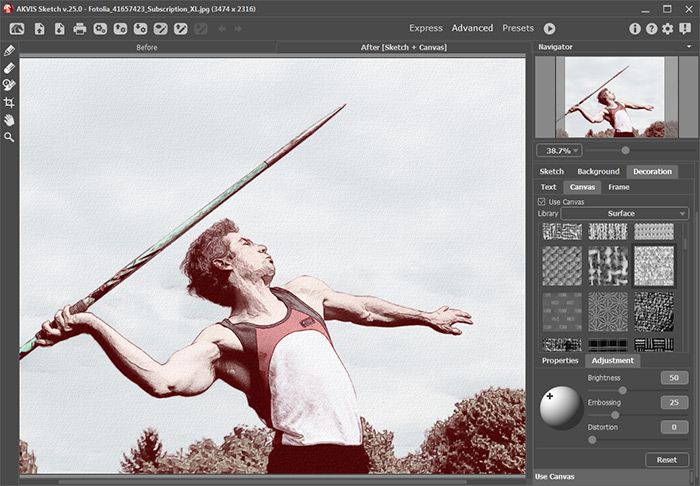
To use this effect, adjust the settings in the Canvas tab.

By default the parameters of the tab are disabled and the sketch comes out as if drawn on plain paper. To activate the parameters of the Canvas tab, select the check-box Use Canvas.

Sketch  drawn on plain paper
The check-box "Use Canvas" is disabled
Change canvas
The check-box "Use Canvas" is enabled


The canvas is generated by reproduction of the chosen texture. These are the following parameters of texture generation and application:

Adjustment of Texture Properties:

  • Texture. Select a texture from the Texture Library. To open the Texture Library, double click with the left mouse button on the square box with a sample texture.
    Sample texture

    Select a texture with a double-click of the mouse.

    It is possible to use your own texture. For this purpose create and save a pattern into a folder on your computer. The pattern can be square or rectangular and must be saved as a JPEG, BMP, TIFF or PNG file.

    To load a texture into AKVIS Sketch, open the Texture Library , click on and select a texture in the Select user texture dialog box.

    To return to the Settings Panel without selecting any texture click on .

    Canvas Tab Texture Library
  • Scale. This parameter sets the size of the repetitive pattern. By default the Scale is set to 100%. The higher the value of the parameter, the larger is the pattern.
    Reduce the scale Increase the scale
    Scale = 70% Scale = 150%
  • These are the following options that define the way the canvas is generated:

      Repetition. When this option is selected, the canvas is generated by simple repetition of the given pattern.

      Repetition of the given pattern
      The option "Repetition" is enabled

      Reflection. When this option is selected, the canvas is generated by repetition of the given pattern.The difference from the Repetition mode is that the ends of the patterns are joined at mirror reflection.

      The ends of the pattersn are joined at mirror reflection
      The option "Reflection" is enabled

      Alignment. Use this option when the original texture is irregular and the texture joins are visible on the final image. This option allows aligning the patterns for a smoother transition.
      Align the patterns Pattern repetition
      The option "Alignment" is enabled Other option enabled


Adjust the parameters of texture application:

  • Light Source. Use the dagger on the ball to set the probable light source during the shooting. The position of the light source influences the texture wrapping. To change the position of the light source, left-click on the required point of the ball.
    Light Source
  • Brightness. This parameter lets you change the texture brightness. The values of the parameter vary between 0 and 150. The brightness of the original texture is 90. The higher the value of the parameter, the lighter is the texture. As a result, the output image gets lighter.
    Reduce Brightness Increase Brightness
    Brightness = 10 Brightness = 90
  • Embossement. This parameter allows a texture to be embossed. The values of the parameter vary between 0 and 150. At 0, the texture is flat. As you increase the value of the parameter, the texture gets more prominent.
    Reduce Embossment Increase Embossment
    Embossment = 25 Embossment = 150
  • Reveal Texture. This parameter defines to what extent the canvas is shown through the image. The values of the parameter vary between 0 and 40. The higher the value, the more distinct is the texture and the less visible is the original image. A higher value of the parameter also increases the influence of the Brightness parameter and the texture contrast.
    Reduce Reveal Texture Increase Reveal Texture
    Reveal Texture = 20 Reveal Texture = 35
  • Distortion. This parameter defines the distortion of the resulting image. The values of the parameter vary between 0 and 50. The higher the value of the parameter, the more distorted and blurred is the image.
    Without Distortion Distortion = 30
    Distortion = 0 Distortion = 30
 
How It Works How It Works
   — Workspace — Workspace
   — How To Use The Program — How To Use The Program
   — Make a Sketch from a Photo — Make a Sketch from a Photo
   — Background Effects — Background Effects
   — Add Text/Signature — Add Text/Signature
   — Imitate Sketch Drawing on a Canvas — Imitate Sketch Drawing on a Canvas
   — Working with the Presets — Working with the Presets
   — Preferences — Preferences
Examples Examples
   — Pencil Sketch: Let's Draw a Tulip — Pencil Sketch: Let's Draw a Tulip
   — Convert a Photo to a Color Sketch — Convert a Photo to a Color Sketch
   — Transform a Video into a Cartoon — Transform a Video into a Cartoon
   — Pastel Drawing Technique — Pastel Drawing Technique
   — Graphite Pencil Portrait — Graphite Pencil Portrait
   — Watercolor Drawing — Watercolor Drawing
   — Artistic Processing — Artistic Processing
   — Watercolor Painting out of Photo — Watercolor Painting out of Photo
   — Winter Dream: Fairy-Tale Forest — Winter Dream: Fairy-Tale Forest
   — A Woman in a Tub: a Real Work of Art — A Woman in a Tub: a Real Work of Art
   — Watercolor Portrait — Watercolor Portrait
   — Pencil Sketch of a Pet — Pencil Sketch of a Pet
   — Postcard Framed in Pencil Drawing — Postcard Framed in Pencil Drawing
   — Baseball Photo to Color Drawing — Baseball Photo to Color Drawing
   — Make a Sketch from a Wolf Photo — Make a Sketch from a Wolf Photo
   — Motorshow: a Pencil Drawing — Motorshow: a Pencil Drawing
   — A Little Girl: B&W Pencil Sketch — A Little Girl: B&W Pencil Sketch
   — Westmuir Street in Glasgow — Westmuir Street in Glasgow
   — Wild Beast of Prey: Watercolor — Wild Beast of Prey: Watercolor
   — A Hand Draws a Hand — A Hand Draws a Hand
   — Convert Vector Drawing to Sketch — Convert Vector Drawing to Sketch
   — Portrait out of a Newspaper Clipping — Portrait out of a Newspaper Clipping
   — Quiet Harbor:  a Watercolor Painting — Quiet Harbor: a Watercolor Painting
   — Sweet Couple: Create a Postcard — Sweet Couple: Create a Postcard
   — Black-and-White Image in Photo Frame — Black-and-White Image in Photo Frame
   — Dream to Reality: How to Blend... — Dream to Reality: How to Blend...
   — Christmas Card from a Photo — Christmas Card from a Photo
   — Artist at Work — Artist at Work
   — Romantic Mood Without Photoshop — Romantic Mood Without Photoshop
   — Stop the Moment! (Sketch&Blur) — Stop the Moment! (Sketch&Blur)
   — Versailles: Traveling to the Past — Versailles: Traveling to the Past
   — Drawing on Aged Paper — Drawing on Aged Paper
   — Self-Expression: Sketch in a Minute — Self-Expression: Sketch in a Minute
   — Two Beloved Dogs — Two Beloved Dogs
   — Orchid: Drawing in Watercolor Pencil — Orchid: Drawing in Watercolor Pencil
   — Shiny Apple: An Artist's Touch — Shiny Apple: An Artist's Touch
   — Cardinal: A Scene From Nature — Cardinal: A Scene From Nature
   — Variations On A Rose — Variations On A Rose


   Privacy Policy | Site Map | Search    
   Contact Us | Twitter | Facebook   
| English  |Français  |Deutsch  |Español  |Português  |Italiano  |日本語  |Pусский  | © 2004-2010 AKVIS Software Inc. All rights reserved.