"Montage" Mode Watch a flash-movie that gives a snap introduction to Montage Mode of the Chameleon plugin: click here to open the tutorial (flash-movie, 4.14 Mb).
Follow the instruction to create a collage using the Montage Mode of AKVIS Chameleon.
In the Montage mode AKVIS Chameleon
combines images to create a seamless photo montage. It transfers selected objects to
a new background and makes the irrelevant parts of the pasted fragment fade away.
The object does not change its color range or opacity. This mode is good to use for creating photo collages with people (pasting a person into a new background).
-
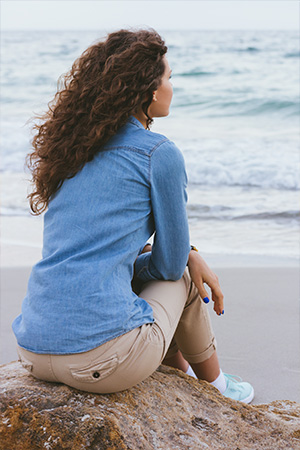
Step 1. Open an image with the object that you want to transfer to a new background.
-
Step 2. Select the object with any selection
tool. The selection does not have to be precise.
-
Step 3. Call AKVIS -> Chameleon – Grab Fragment from the Filter menu of the photo editor.
Adobe Photoshop - Filter –> AKVIS –> Chameleon – Grab Fragment; Paint Shop Pro - Effects –> Plugins -> AKVIS –> Chameleon – Grab Fragment; Corel PHOTO-PAINT - Effects –> AKVIS –> Chameleon – Grab Fragment.
If everything is done correctly you’ll see a message that
selected object is saved into the clipboard.
-
Step 4. Open an image that will be used as a background for the future
collage
and call the command AKVIS –> Сhameleon – Make Collage from
the menu Filters.
Adobe Photoshop - Filter –> AKVIS –> Chameleon –
Make Collage; Paint Shop Pro - Effects –> Plugins -> AKVIS –> Chameleon
– Make Collage; Corel PHOTO-PAINT - Effects –> AKVIS –> Chameleon –
Make Collage.
The AKVIS Chameleon window will open. The window
will contain the background image and the pasted object.
-
Note: If you begin with the step 4, the window
will show the last used inserted fragment.
-
Step 5. Press the left-mouse button in the drop-down menu in the
Settings panel and choose the Montage mode.
- Step 6.
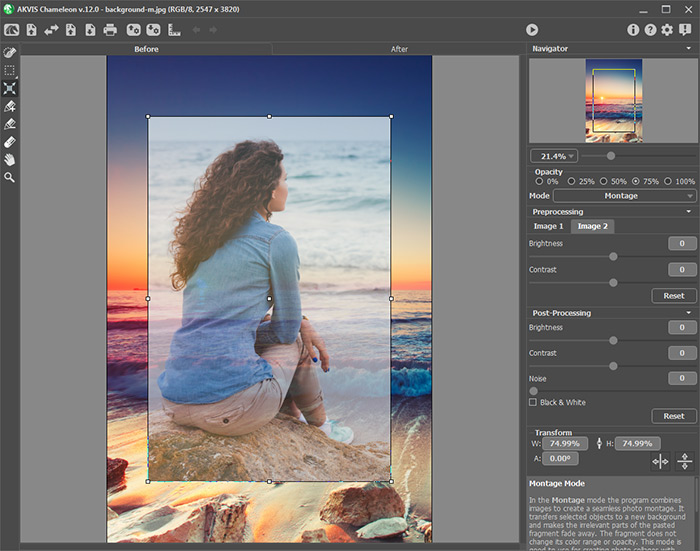
Set the value of the Opacity parameter. This parameter
is auxiliary and does not affect the final result. Use it
when you need to position the fragment on the image at a high accuracy. The
parameter can have the following values: 25%, 50%, 75%, and 100%. With 100%
the pasted object is non-transparent. The lower the value of the parameter, the more
transparent is the fragment.
-
Step 7.
Use the Transform tool
from the Toolbox to change the size, the position, and the rotation
angle of the pasted fragment on the background image. If you press the button
(T) a
dotted frame will appear and the Settings panel will show the transformation
parameters.
To change the size of the object, bring the cursor to the dotted
frame. The cursor will turn into a two-sided arrow .
Keeping the left mouse button pressed, increase or reduce the size of the
fragment. Besides, you can scale the image by changing the parameters W
(width) and H (height).
There is a proportion sign
between the parameters W and H. If this option is enabled the
image will be scaled proportionally, if it is disabled you can set your own
parameters.
To rotate an object, bring the cursor to one of
the angle markers to get a rounded two-arrows pointer ,
move the pointer keeping the left mouse button pressed. You can rotate an
object by setting the parameter A (angle) to a value between 0 to 360
in the Settings panel.
To move an object bring the cursor inside the object, the
cursor will turn into a cross .
Move the object keeping the left mouse pressed.
-
Step 8. Edit the contours. You will need the following tools:
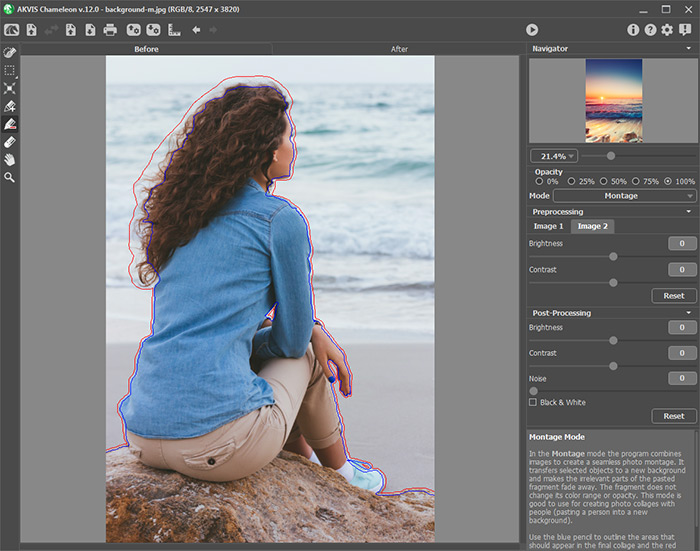
Keep Area Tool . Use this tool to outline the areas of the fragment that should be part of the photo collage. For example, if you want to keep a human figure, draw an outline within it with the blue pencil. You can activate this tool by pressing the button K on the keyboard.
Drop Area Tool . Use this tool to outline the unnecessary parts of the fragment, the parts that should disappear. You can activate this tool by pressing the button D on the keyboard.
Eraser Tool . Use this tool to erase drawn outlines. You can activate this tool by pressing the E-key on the keyboard.
Please note that the red outer frame can not be erased, it is used to define the limits of the pasted fragment.
To draw an outline, activate the Keep Area Tool
or the Drop Area Tool, bring the cursor to the required point on the image, press the left mouse-button and, keeping it pressed, draw an outline.
The brush size of the Keep Area Tool
or the Drop Area Tool can be changed using the check-box Thick Strokes in the Settings panel. By default this
check-box is enabled and the brush strokes are thick. If you work with small
details, you can disable this option (with a left-click on the check-box).
To erase a drawn contour, activate the Eraser
tool (the button E).
Bring the cursor to the contour and draw over the contour keeping the left-mouse
button pressed. To make the process more convenient, use the right-mouse button to switch to Eraser tool when drawing with Keep Area or Drop Area tool. In this way, you can correct the outlines quickly without having to switch to Eraser in the Toolbar.
The size of the Eraser tool can be changed using the Eraser Size parameter in the Settings panel.
-
Step 9. Click on
button to start the process of collage creation. The result will be shown
in the After tab. You can switch between the tabs using the button
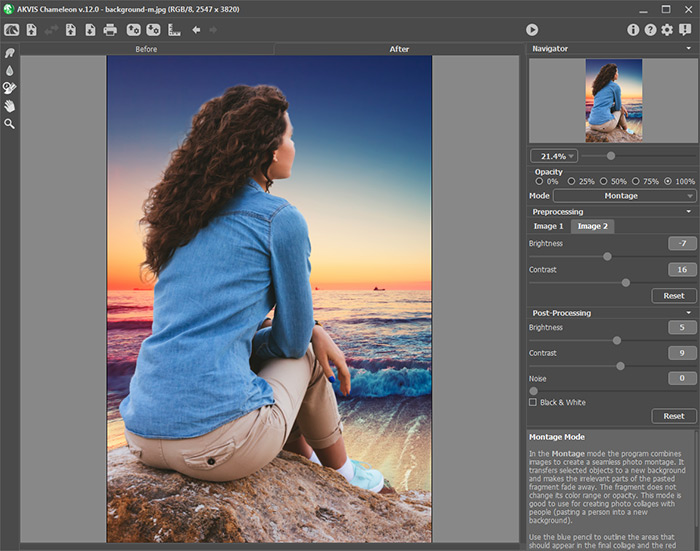
Tab.
If you are not satisfied with the result, switch to Before tab (the button Tab) and draw the contours more accurately. Then press the button again.
- Step 10. You can save the fragment used for the collage: press the
button
( Ctrl+S
(Command+S on Macintosh) hot-key) on the Control
Panel, in the Save fragment and strokes dialog box enter a name
for the file and indicate a folder to which you want to save the file.
The fragment will be saved with the .chameleonFragment extension. The file will also contain information about the fragment's location, the settings, and, in case of the Montage mode, the drawn contours.
Open the saved fragment with the button (Ctrl+O (Command+O on Macintosh) hot-key) and choose the fragment in the Load fragment and strokes dialog box.
-
Step 11. Click on
to apply the result and close the plugin window.
| |
|