Graphic software for Windows Mac graphic software
Please enter your email to be kept posted on updates and discounts:
 
  
  Products     Download     Online Store     Tutorial     Support     Company
en  fr  de  es  pt  it  jp  ru    
 

Tutorial: AKVIS Chameleon

"Emersion" Mode


Follow the instructions to create a collage using the Emersion Mode of AKVIS Chameleon.

AKVIS Chameleon offers four collage modes: Montage, Chameleon, Blend and Emersion.

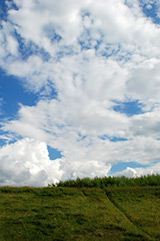
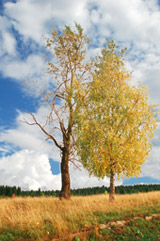
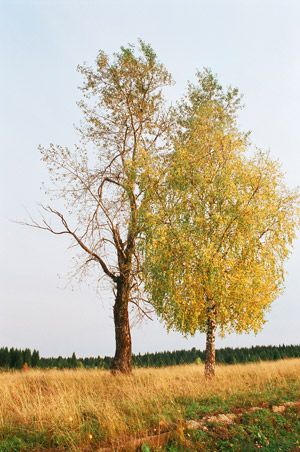
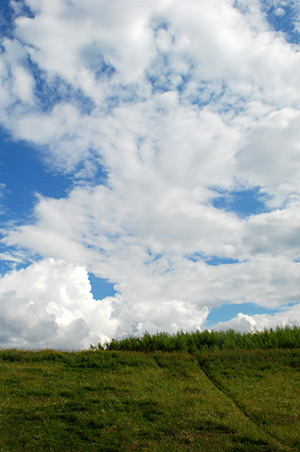
In Emersion mode, like in Montage mode, the program combines images to create a seamless photo montage. The difference between the two is that in Emersion Mode the pasted fragment does not overlay the background, but embeds into the background so that only certain parts of the fragment are visible. This mode allows making montages with difficult objects (trees, etc).
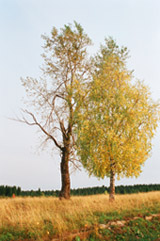
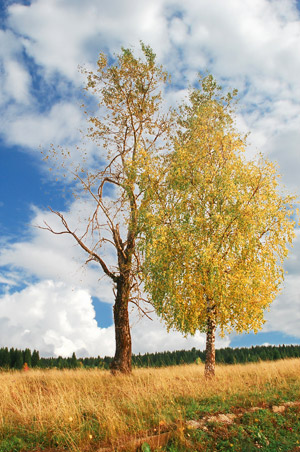
A background image for a collage A source image for a collage Photo collage - Emersion mode
Original imagesResult

The mode is called Emersion because what it actually does is make the background "emerse" through the object. This characteristic distinguishes it from other modes, as in Montage, Chameleon and Blend modes the program mostly works with the object itself, not with the background.

Follow these steps to create a montage in Emersion mode:

  • Step 1. Open the image which contains a fragment for the montage.
    Open the image which contains a fragment for the montage
  • Step 2. Use any selection tool to select the required fragment.

    Attention!

    In Emersion mode it is critical to make a precise selection. If needed, process the edges of the fragment before you paste it into the main image.

    Making a selection
  • Step 3. Call the command AKVIS -> Chameleon – Grab Fragment in the Filter menu of your photo editor.

    In Adobe Photoshop select the menu item Filter –> AKVIS –> Chameleon – Grab Fragment; in Paint Shop Pro: Effects –> Plugins -> AKVIS –> Chameleon – Grab Fragment; in Corel PHOTO-PAINT: Effects –> AKVIS –> Chameleon – Grab Fragment.

    If everything is done correctly, you’ll see a message that the selected object is saved into the clipboard.

  • Step 4. Open the image that will be used as a background for the future montage

    The background  image for the collage

    and select the command AKVIS –> Сhameleon – Make Collage in the Filter menu of your photo editor.

    In Adobe Photoshop it is the command Filter –> AKVIS –> Chameleon – Make Collage; in Paint Shop Pro: Effects –> Plugins -> AKVIS –> Chameleon – Make Collage; in Corel PHOTO-PAINT: Effects –> AKVIS –> Chameleon – Make Collage.

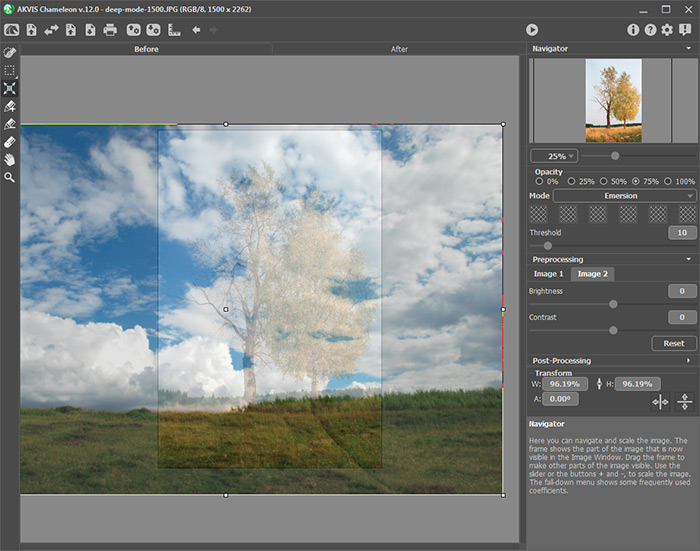
    The AKVIS Chameleon window will open. The workspace will contain the background image and the pasted object over it.

    The Chameleon plugin window
  • Step 5. By default Montage mode is activated. Choose Emersion mode in the drop-down menu Mode in the Settings panel.
  • Step 6. Adjust the position of the pasted fragment. You can use the Opacity parameter for a more precise positioning of the fragment on the background. The parameter can have the following values: 0%, 25%, 50%, 75%, and 100%. With 100% the pasted object is solid. The lower the value of the parameter, the more transparent is the fragment.

      Remark: The Opacity parameter is auxiliary and does not influence the final result.

  • Step 7. Use the Transform tool Transform from the Toolbar to change the size, the position, and the rotation angle of the pasted fragment on the background image. If you press the button Transform (T) a dotted frame will appear and the Settings panel will show the transformation parameters.

    The Chameleon plugin in Emersion mode

    To change the size of the object, bring the cursor to the dotted frame. The cursor will turn into a two-sided arrow  . Keeping the left mouse button pressed, increase or reduce the size of the fragment. You can also scale the image by changing the parameters W - Width and H - Height.

    There is a proportion sign  between the parameters W and H. If this option is enabled the image will be scaled proportionally, if it is disabled you can set your own parameters.

    To rotate an object, bring the cursor to one of the angle markers to get a rounded two-arrows pointer  , move the pointer keeping the left mouse button pressed. You can rotate an object by setting the parameter A - Angle to a value between 0 to 360 in the Settings panel.

    To move an object bring the cursor inside the object, the cursor will turn into a cross  . Move the object keeping the left mouse pressed.

    Attention!

    Click on the Enter-key (Return on Macintosh) to accept the changes made with the Transformation tool.

  • Step 8. Define the zones that will be replaced with that of the fragment. The zones are defined in accordance with their colors and are regulated by the following parameters:
    • Colors field. This field contains a set of colors that will be taken into consideration when processing the image. All pixels of the background image having the colors defined on the color set and close to them will be replaced with the points of the fragment.
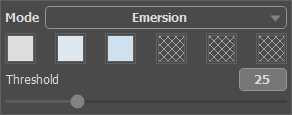
      Colors
      A color set

      The set has 6 color squares. By default these color squares are empty. If you start image processing now, all pixels of the background image will stay the same and we will get the original background photo as a result.

      To set a color, click on an empty square, the pointer will be transformed into an eyedropper, and pick a color from the image with a left-click. This square will display the chosen color.

      To change the color of the square, left-click on it and choose a color from your image.

      To delete a color and clear the square, right-click on the square. The square will return to the default state.

    • The Threshold parameter defines pixels (zones) of the backgroun image that will be replaced with the pixels (zones) of the fragment. At minimum value of the parameter only the colors from the color set are involved into the process. If you increase the value of the parameter the colors similar to the colors of the set will be replaced, too. The higher the value of the parameter, the more pixels of the background will be replaced with the pixels of the fragment; the more of the fragment will be "implanted" into the background.

    Attention! In this mode all work is done only with the background image. The pasted fragment does not change at all.
  • Step 9. Click on to create a collage. The result will be shown in the After tab. You can switch between the tabs using the button Tab.
    If not satisfied with the result, switch to the Before tab, change the colors, adjust the Threshold and click on again.

  • Step 10. After processing, you can save the fragment used for the collage: click on (Ctrl+S (+S on Macintosh) hot-key) on the Control Panel, in the Save fragment and strokes dialog box enter a name for the file and indicate a folder to which you want to save the file.

    The fragment will be saved with the .chameleonFragment extension. The file will contain information about the fragment's location and the settings.

    To open the saved fragment, click on (Ctrl+O (+O on Macintosh) hot-key) and choose the fragment in the Load fragment and strokes dialog box.

  • Step 11. Click on to apply the result and quit the program.

    Composition of images
 
Workspace Workspace
How It Works How It Works
Montage Mode Montage Mode
   — Photo Hunting — Photo Hunting
   — Snow Windserfing — Snow Windserfing
   — Serenade for a Gull — Serenade for a Gull
Chameleon Mode Chameleon Mode
   — To Sail Beyond the Sunset — To Sail Beyond the Sunset
   — Changing Appearance — Changing Appearance
   — Try on a Tattoo — Try on a Tattoo
   — Monkey and a Mask — Monkey and a Mask
   — Coffee postage stamp — Coffee postage stamp
   — Lemonade Label — Lemonade Label
   — Chameleon in the Fire — Chameleon in the Fire
   — The Flying Dutch — The Flying Dutch
   — Flowers and a Cat — Flowers and a Cat
   — Elephant in the Savanna — Elephant in the Savanna
   — Archeological Reconstruction — Archeological Reconstruction
   — The Swan Lake — The Swan Lake
   — An Earth View — An Earth View
   — Collage with a Girl — Collage with a Girl
   — Help the Dove — Help the Dove
   — A Girl in the Sunset — A Girl in the Sunset
   — A Greeting Card — A Greeting Card
   — Moonlight Sonata — Moonlight Sonata
   — Enliven the Scenery — Enliven the Scenery
   — Photo Collage in Corel Photo-Paint — Photo Collage in Corel Photo-Paint
Blend Mode Blend Mode
   — Wood Painting — Wood Painting
   — Creating a Greeting Postcard — Creating a Greeting Postcard
   — Valentine Card — Valentine Card
   — Autumn Collage — Autumn Collage
   — Butterfly on the Wall — Butterfly on the Wall
   — Dove in the Fire — Dove in the Fire
   — Fantastic Collage — Fantastic Collage
   — Blazing Photo of a Girl — Blazing Photo of a Girl
   — A Wedding Photo Collage — A Wedding Photo Collage
   — Fairy Tale Illustration — Fairy Tale Illustration
   — Ripe Cherries — Ripe Cherries
   — Sky Swapping — Sky Swapping
   — Creative Design in Paint Shop Pro — Creative Design in Paint Shop Pro
   — Time Goes by Like Water — Time Goes by Like Water
   — Wallpaper with a Leopard — Wallpaper with a Leopard
Emersion Mode Emersion Mode
   — For Graffiti Fans — For Graffiti Fans


   Privacy Policy | Site Map | Search | English  | Français  | Deutsch  | Español  | Português  | Italiano  | 日本語  | Pусский  | © 2004-2008, AKVIS Software Inc. All rights reserved.