History of Photography: How It All Began...
Photography (after the Greek photo – light and graph – draw, write) – light drawing or light writing was not discovered at once or by a single person. This discovery had accumulated from the work of many generations of scientists from different countries of the world.
People had always looked for a way to get pictures without the long and tedious work of an artist.
It was noticed ages ago that a sunbeam penetrating through a tiny hole into a dark room would leave a light drawing of the outer world objects on a surface. The objects are depicted in exact ratio and colors but their size is diminished in comparison to reality and they are seen upside down. This peculiarity of the dark room (camera obscura) was already known to the ancient Greek philosopher Aristotle who lived in IV BC. The principle of the camera obscura operation was also described by Leonardo da Vinci.
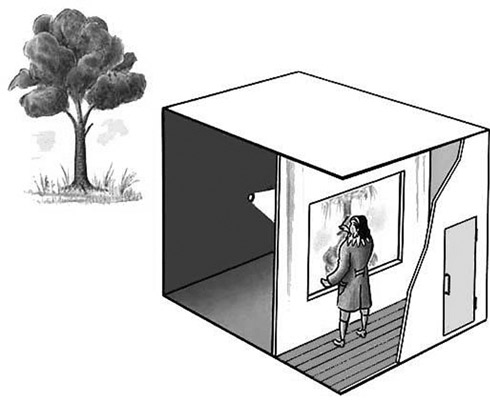
Camera Obscura
It is known that glasses were invented as far as the 1300. The spectacle lens led to the Galileo Galilee spyglass. The great Russian scientist Lomonosov started the development of fast lenses and other optics.
Then came the time when advances led to a camera obscura that was a box with a biconvex lens in the front side and semitransparent paper or opal glass in the back. This equipment was used for mechanical drawing of real objects. The upside down image could be easily put upright with the help of a mirror and outlined on a piece of paper with a pencil.
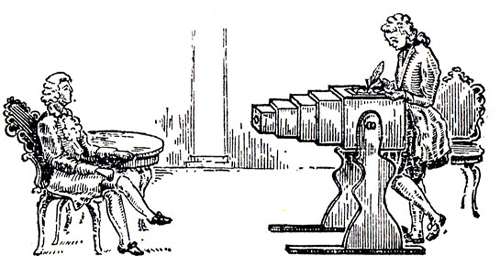
Camera Obscura for Mechanical Sketching of Objects
In the middle of the 18th century Russia a camera obscura became wide spread called "makhina dlya snimania pershpektiv" (a machine for taking perspectives), made as a marching tent. It helped to depict documental views of Petersburg, Petergoff, Kronstadt and other Russian cities.
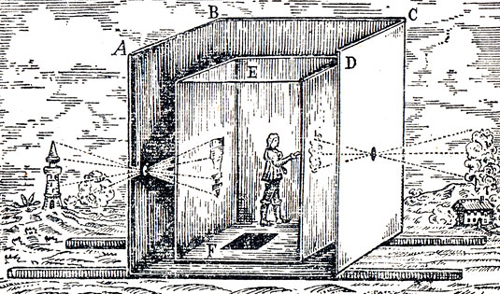
Camera Obscura (Ancient Drawing)
It was "photography before photography". The work of an artist was simplified. But to make it mechanical was not enough. People wanted to learn not only to focus a "light drawing" in the camera obscura but to fix it fast on a surface by chemicals.
But while optics for the invention of photography were developed many centuries back, in it was not until the 1700's that chemistry became well developed as a science.
One of the most important factors leading to the invention of a way to transform an optical pattern into a chemical process in a light-sensitive layer was a discovery made by a young Russian amateur chemist Bestuzhev-Rjumin (1693 - 1766), who would later become a prominent statesman and diplomat, and a German anatomist and surgeon J.H. Schulze (1687-1744). Developing liquid treatments in 1725 Bestuzhev-Rjumin noticed that iron salt solutions change their color under sunlight. In two years Schulze produced proof of bromine salt's photosensitivity.
But scientists and inventors from different countries began to purposefully work on chemical fixing of a camera obscura light image only in the first third of the 19th century. Best results were achieved by Frenchmen Joseph Nicéphore Niépce (1765 - 1833), Louis Jacques Mande Daguerre (1787 - 1851), and an Englishman William Fox Talbot (1800 - 1877). These are the people who are known as inventors of photography to the whole world now.
Although there were some attempts to obtain a photo image as far as 1700's, the year of photography invention is considered to be 1839, when so called daguerrotypy appeared in Paris. Using the results of his own investigations and the experiments of Nicéphore Niépce the French inventor Louis Daguerre had a success with photographing a man and getting a stable photo image. The exposure time reduced in comparison to earlier tests (less than 1 min) as well. In contrast to modern photography, which produces a negative, daguerreotype produced a positive that made it impossible to have many copies.