History of Photography: Niépce Pictures
Niépce Joseph Nicéphore (March, 7, 1765, Chalon-sur-Saone, France — July, 5, 1833, ibidem) was a French inventor, and one of the creators of photography. He was the first to find a way to fix an image produced by a camera obscura (around 1820s) using bitumen cutback as the photosensitive substance (heliography). He cooperated with L.Daguerre since 1829.
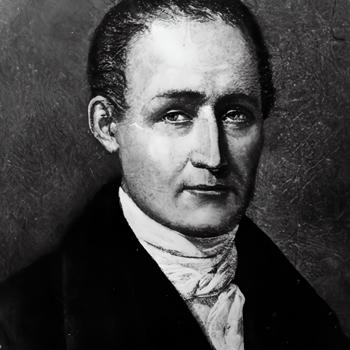
Joseph Nicéphore Niépce
Nicéphore Niépce was born to a rich family. His father was the king's councilor and his mother - a daughter of a well known lawyer. In his childhood, Niépce showed a great interest in the invention process but was preparing for an ecclesiastical carreer; he quit it in 1792 to become an army officer. Niépce left the army in the first period of the French revolution because of his royalist sympathies. When Napoleon came into power Niépce returned into the army and took part in Sardinian and Italian military operations. He retired due to health problems and was a statesman in Nizza for a few years. In 1801 he returned home to Chalon and together with his brother Claude devoted the rest of his life to scientific investigations.
Before 1813, Niépce had for many years been occupied with increasing the quality of planographic printing, lithography, invented by A. Senefelder in 1796. The heavy Bavarian limestone used by Senefelder as a printing form was replaced by Niépce with a sheet of tin. His son made color drawings with a bold pencil on it. Niépce himself could not draw and after his son had been drafted he started experiments with silver salts. He aimed at making the light "to draw". The target was achieved with the help of bitumen cutback attenuated in animal oil. He deposited this solution onto a plate made of glass, copper and tin-lead alloy and exposed it in a camera obscura for several hours. Consequently, the first "photo paper" was made of asphalt (!). When the image on the coating hardened and became visible with the naked eye Niépce processed the plate with an acid in the dark room. The acid dissolved the coating over the lines of the image covered from light during the exposure process and left soft and soluble (other sources say the asphalt was washed out with lavender oil and kerosene). After that, an engraver engraved clear lines, covered the plate with ink and printed the needed quantity of copies as it had been done before from any etched or engraved plates. The result of this was an engraving created not by an artist but by light - heliography (after the Greek "of the sun"). Niépce obtained his first stable image from a camera obscura in 1822. But the only surviving heliographic image is one from 1826, from the time when Niépce begun to use the alloy of tin and lead instead of copper and zinc plates. The exposure took 8 hours (!).
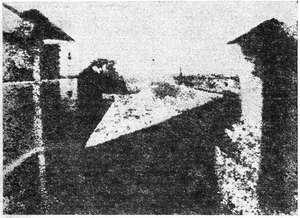
In such a way Niépce, for the first time in history, managed to fix an exact image of an object "drawn" by light. In order to do it he used one of the photo sensitive materials - bitumen cutback. But he also had to use the work of an engraver. This kind of heliogravire was only the initial stage in the invention of photography. Heliogravires were not very clear. Niépce invented an aperture for correction of the image defects arising from the camera obscura open lens.
In 1827 Niépce met Louis Daguerre - the rich and prosperous owner of the Paris Diorama who offered him cooperation. The 64 year old Niépce, in declining health and in need for funds for his investigations, signed a 10-year contract with Daguerre in 1829 to develop the opened by Niépce method of "fixing nature images without an artist". There was a term clause in the contract according to which Niépce' son Isidore would become an heir in case of Niépce death before the end of the contract. Niépce sent to Daguerre a detailed description of his heliographic process and showed the technology. Daguerre had to come to Chalon to see it . They never met after that: each of them worked over his own invention independently.
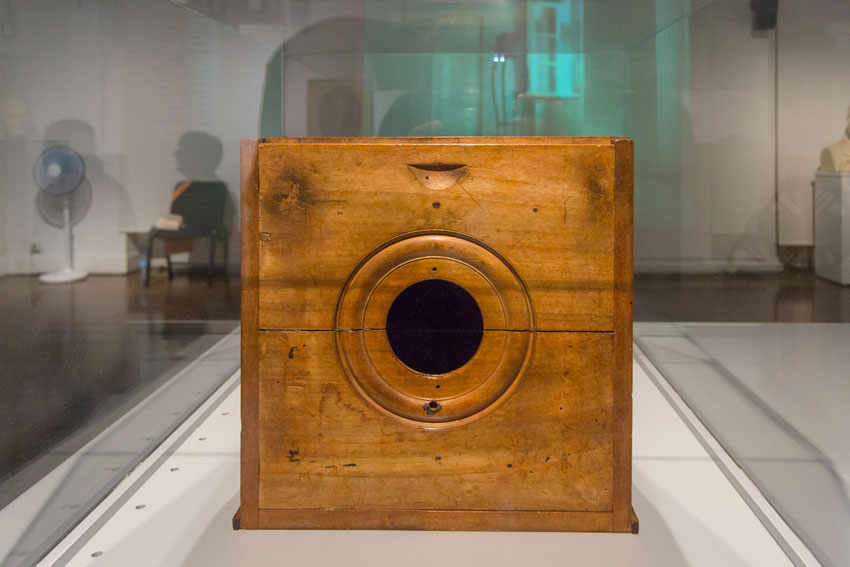
Niépce Camera