Working with AKVIS MultiBrush, Photo Retouching Software


AKVIS ニュースの購読を申し込むには, 電子メールアドレスを入力してください。
 
 
  プログラム     ダウンロード     サイバーショップ     チュートリアル     サポート     会社情報      お客様の部屋
en  fr  de  es  pt  it  jp  ru    
 

チュートリアル: AKVIS MultiBrush

How it Works


あいにく, このページは英語にだけ使用可能です。日本語のバージョンは遠からず出ります。
Attention! You can get a free licence for an AKVIS program by translating texts from English to Japanese.
Please contact us at team@akvis.com.

AKVIS MultiBrush can work independently as a standalone program and as a plug-in to a photo editor.

Follow the instructions below:

  • Step 1. Run the standalone edition of AKVIS MultiBrush or open your photo editor (if you work with the plugin version of AKVIS MultiBrush).
  • Step 2. Open an image or create a new image.

    - If you work with the plugin:

    Open an image in your photo editor by calling the command File -> Open or using the key combination Ctrl+O (+O on Macintosh).

    - If you work with the standalone edition:

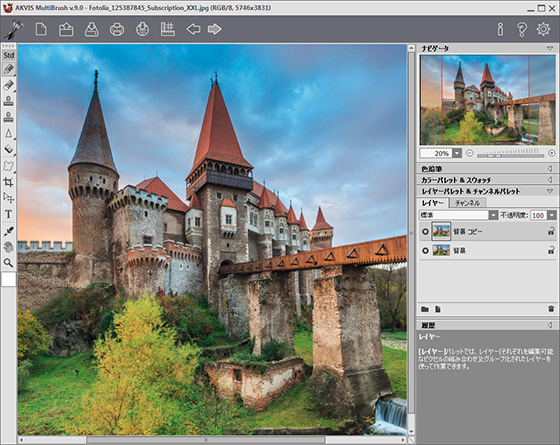
    The dialog box Select file to open appears if you double-click on the empty workspace of the program, if you click on the button on the Control Panel or if you use the key combination Ctrl+O (+O on Macintosh). You can also drag the required image into the workspace of the program. The Standalone edition of AKVIS MultiBrush supports BMP, JPEG, PNG, TIFF and PSD file formats.
    The AKVIS MultiBrush window
    The AKVIS MultiBrush window
  • Step 3. In plug-in version only: call the AKVIS MultiBrush plug-in. For this purpose in Adobe Photoshop select the menu item Filter -> AKVIS -> MultiBrush; in Paint Shop Pro select the menu item Effects –> Plugins -> AKVIS –> MultiBrush; in Corel PHOTO-PAINT select the menu item Effects -> AKVIS -> MultiBrush.
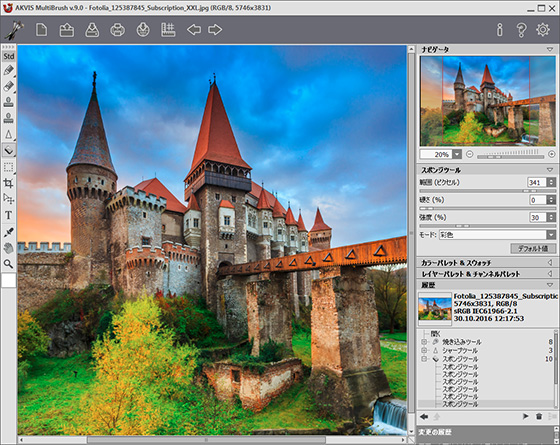
  • Step 4. Use the editing tools in the Toolbar to process the image (to learn how to use the editing tools in more detail, look at this example).
    Editing the image
    Editing the image
  • Step 5. In plug-in version only: press the button to apply the result and close the plugin window. The AKVIS MultiBrush plugin will close and the picture will appear in the workspace of the photo editor.
  • Step 6. Save the processed image.

    - If you work with the plugin:

    Call the Save As dialog box using the command File -> Save As, enter a name for the file, choose the format and indicate the target folder.

    - If you work with the standalone edition:

    Click on the button or use the key combination Ctrl+S (+S on Macintosh) to open the Save as dialog box. Enter a name for the file, choose the format (TIFF, BMP, JPEG, PNG or PSD) and indicate the target folder.
  • Step 7. The standalone edition of AKVIS MultiBrush lets you print the image. For this purpose press the button or use the key combination Ctrl+P (+P on Macintosh), adjust print settings in the Print dialog box and press the button Print.
  • Step 8. Close the program AKVIS MultiBrush.


操作方法 操作方法
   — ワークスペース — ワークスペース
   — 操作方法 — 操作方法
   — 新規ドキュメントの作成 — 新規ドキュメントの作成
   — 環境設定  — 環境設定
パレット パレット
   — ツールバー — ツールバー
   — カラーパレット — カラーパレット
   — スウォッチ — スウォッチ
   — ヒストリーパレット — ヒストリーパレット
   — レイヤーパレット — レイヤーパレット
   — チャンネルパレット — チャンネルパレット
標準ブラシ 標準ブラシ
   — カラーブラシ — カラーブラシ
   — 色鉛筆 — 色鉛筆
   — スプレーツール — スプレーツール
   — 消しゴム — 消しゴム
   — 履歴ブラシ — 履歴ブラシ
   — スタンプツール — スタンプツール
   — カメレオンブラシ — カメレオンブラシ
   — ぼかしツール — ぼかしツール
   — シャープツール — シャープツール
   — こするツール — こするツール
   — 覆い焼きツール — 覆い焼きツール
   — 焼き込みツール — 焼き込みツール
   — スポンジツール — スポンジツール
アートブラシ アートブラシ
   — 油絵用ブラシ — 油絵用ブラシ
   — ローラー — ローラー
   — フェルトペン — フェルトペン
   — チョーク — チョーク
   — 鉛筆(アーティスティック) — 鉛筆(アーティスティック)
   — スプレー(アーティスティック) — スプレー(アーティスティック)
   — 消しゴム(アーティスティック) — 消しゴム(アーティスティック)
Additional Tools Additional Tools
   — スポイト — スポイト
   — 手のひらツール — 手のひらツール
   — ズームツール — ズームツール
操作例 操作例


ページの先頭へ


   プライバシー | サイトマップ | Web サイトの検索    
   連絡先 | Twitter | Facebook | YouTube Channel    
| English  |Français  |Deutsch  |Español  |Português  |Italiano  | 日本語  |Pусский  | © 2004-2012 AKVIS. All rights reserved.