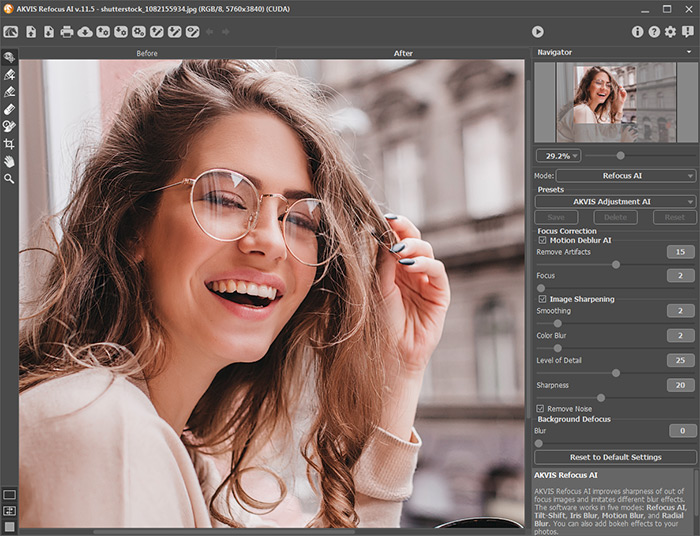
Focus Mode in Standalone edition In Focus mode the program improves sharpness of blurred images. It happens when the camera fails to focus on the subject and it comes out unsharp. This mode can save such out-of-focus images. You can refocus the whole image or bring only certain a element of the image into focus.
Follow the steps below to improve the focus of your image using AKVIS Enhancer:
- Step 1. Launch AKVIS Enhancer.
- Step 2. Open the original image. For this purpose click on the button
in the Control panel and select the required file in the Open dialog box. AKVIS Enhancer supports the following formats: BMP, JPEG, TIFF and PNG.
- Step 3. Choose the Focus mode in the Settings panel.
The photo will be processed with the default parameter values (the AKVIS Default preset in the list of presets).
The result will be shown in the After tab in the preview area.
The Preview Area represents a dotted frame. You can drag the frame (the button ) or draw it anew on any part of the image, thus analyzing different parts of the photo.
With a left-click on the image you can temporarily switch to the Before tab and compare the result of automatic focusing with the original photo in the preview window.
- Step 4. You can adjust the settings to achieve the best result
The Manual focusing parameter imitates the focus ring of a digital camera. The values vary between 0 and 100. For different images the optimum value will differ.
The Sensitivity parameter influences on the level of detail. If you increase the value of the parameter, the details get clearer. It is not recommended to use high values of this parameter as it may reveal much noise.
The Intensify parameter is closely related to the previous parameters. If you increase the value of this parameter, the effect of the previous parameters will increase, too.
Set the value of the overlay parameters that define
the final result of re-focusing:
-
The Darken parameter. The result of focusing
is compared with the original image. If the color of the pixel on the
original image is lighter than the color of the pixel on the resulting
image, it is replaced by the darker pixel. If the color of the pixel
on the original image is darker than the color of the pixel on the resulting
image, this pixel doesn't change its color. The higher the value of
the parameter, the darker are the pixels. As a result the image contrast
will change too.
-
The Lighten parameter. This parameter works
in the same way as the Darken parameter, but the pixels of the
original image are replaced with the lighter pixels.
The real result of the focusing can be seen if you set
the value of both parameters to 100. However, it may cause noise.
When the value of the parameters is lower than 100, the
result of focusing is blended with the original image. That is why the final
result looks more realistic.
If the value of these parameters is 0, the resulting image
will coincide with the original image.
- Step 5. To start the process, click on the button
.
If you want to process only certain areas of your image, you should define them using the following tools.
The Effect Area tool (button ). Use the blue pencil to outline the areas that should be processed.
The No Effect Area tool (button ). Use the red pencil to outline the parts that mustn’t be processed.
The Eraser tool (button ). Use the tool to erase the drawn strokes.
Adjust the stroke width and the eraser size by changing the value of the Brush Size parameter on the Settings panel.
Note: |
It is better to draw a closed outline around the objects. Otherwise the effect can extend over the drawn borders. |
Press the button to start the process.
- Step 6. If needed, you can correct the image further in the Post Processing tab.
- Step 7. If you like the settings of both tabs, you can save them as a preset and use later. To save the settings, enter a name for the preset into the Presets field and press the button Save.
Next time you launch the program, these settings will be used by default. To return to the initial settings of the program, click on Reset.
To process the image with a certain preset, select this preset from the fall-out list to start the process.
To delete a preset, select it from the list and click on the button Delete.
- Step 8. Save the processed image into a file. Click on
in the Control panel to open the Save As dialog box. Enter a name for the file, define its format (JPEG, BMP, TIFF or PNG) and select the destination folder.
- Step 9. It is possible to print the image.
- Step 10. Close AKVIS Enhancer by clicking on
.
| |
|