Crear una imagen nueva
Esta es la ventana del cuadro de diálogo Imagen nueva:
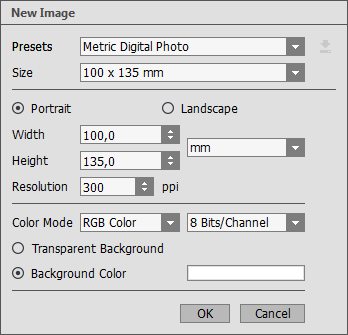
Ventana "Imagen nueva"
El menú desplegable Presets (predeterminados) contiene los tipos de archivo estándar que se utilizan para imprimir o trabajar en Internet. El menú Tamaño muestra los tamaños disponibles para cada uno de los predeterminados. El resto de los parámetros de dichos archivos se configurará automáticamente. Por norma general, los predeterminados tendrán una orientación vertical (Retrato) y el Color de fondo del documento será blanco.
Cualquier modificación realizada en los parámetros de un predeterminado hará que su nombre en el menú desplegable cambie a Personalizado y que a su lado se active el botón Guardar predeterminado personalizado  . Pulse este botón para guardar la configuración actual. A los predeterminados se les asignará automáticamente un nombre que es posible modificar introduciendo cualquier combinación de letras y números en el campo iluminado. Tras pulsar la tecla Intro, en la lista aparecerá el nuevo predeterminado. Para eliminar un predeterminado de usuario, basta con seleccionarlo y pulsar el botón Eliminar predeterminado personalizado
  .
.
Existen dos orientaciones posibles para los documentos: Retrato (vertical) y Álbum (horizontal). En la orientación horizontal, la anchura de la imagen es mayor que la altura, mientras que en la orientación vertical, su altura es mayor que la anchura.
El tamaño de los documentos se puede ajustar manualmente a través de los campos Anchura y Altura. Las unidades se enumeran en una lista desplegable (píxeles, pulgadas, centímetros, milímetros, puntos y picas).
El parámetro Resolución hace referencia a la densidad de píxeles en una imagen (nivel de detalle) y calcula el número de píxeles por pulgada (ppp).
En el Modo color es posible elegir uno de los siguientes esquemas de color: escala de grises, RGB, CMYK y Lab. Los modos difieren en la manera en la que administran el color. Una vez definido el modo de color, es preciso elegir la profundidad del mismo a partir de la lista adyacente: 8 bits/canal, 16 bits/canal o 32 bits/canal.
La opción Fondo transparente aplica un fondo transparente a la imagen, mientras que la opción Color de fondo permite rellenar la imagen con un color de fondo opaco (el valor predeterminado es blanco). El color se selecciona a partir del cuadro de diálogo Seccionar color, que se activa haciendo doble clic sobre la barra de color adyacente.